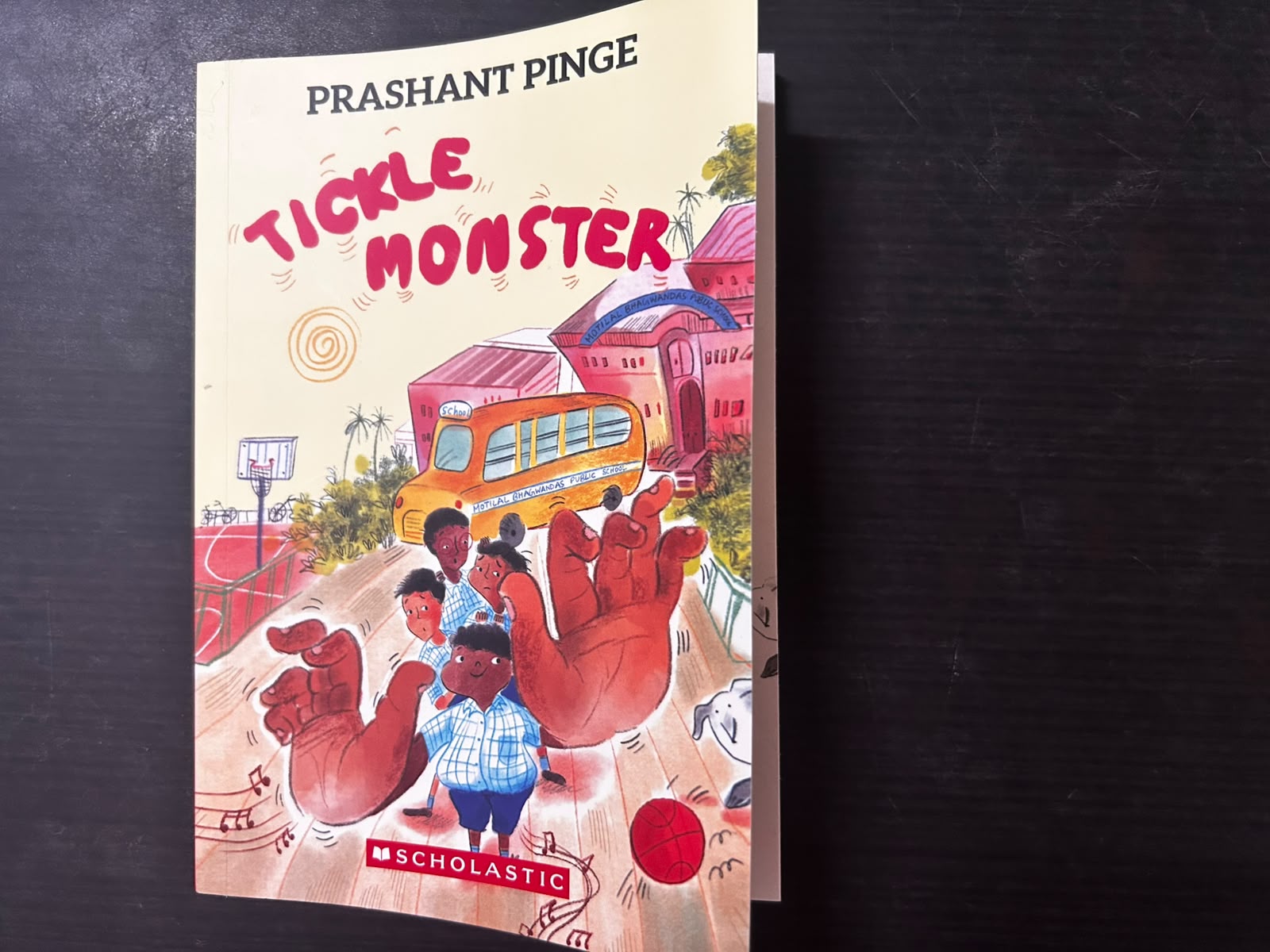
Book: Tickle Monster
Author: Prashant Pinge
Illustrations: Chandrima Chatterjee
Publisher: Scholastic India
Type: Paperback
Length: 88 pages
Recommended Age Group: 7-10 years (Independent Readers) | A delightful read-aloud for younger children too.
Meet Swami, Nivaan, Aarav and Daksh—the best of friends who have perfected the art of making a school-bus ride far more entertaining than it has any right to be! Their daily journey to school is packed with chatter, jokes, goofing around and, presumably, very little peace for the person sitting nearby. 😄
Then there is Param—the studious, clever child in the class. You know the one. The child every parent secretly (or not so secretly!) wishes their own child would become. Needless to say, Swami is not Param’s biggest fan.
For some inexplicable reason, whenever Swami looks at Param, he gets this overwhelming urge to TICKLE HIM.
And one unfortunate day, Param dozes off on the bus. Swami simply cannot resist. One tickle leads to another, Param tumbles off his seat, the children burst out laughing—and Swami discovers something he probably should NOT have discovered: he likes the feeling of the power that comes with it!
And thus begins the rise of… THE TICKLE MONSTER! 👹😂
What starts as one harmless prank soon turns into an uncontrollable habit. Swami feels compelled to tickle anyone and everyone. Before long, his fingers seem to have developed a mind of their own, constantly whispering, “Go on… just one little tickle!” 😂
Soon, children start avoiding Swami like he is carrying a contagious disease. They invent hilarious strategies to escape him, and the author has handled these portions brilliantly. My daughter was laughing her lungs out imagining what it would actually be like if a real-life Tickle Monster were roaming around her school!
But the consequences aren’t funny anymore when Swami’s own friends begin to distance themselves from him. Other children start resenting them simply because they are friends with the Tickle Monster. They try to reason with Swami, but he takes everything as an attack. Eventually, the friendship cracks.
And then comes the master plan.
Swami’s friends have had enough and decide to teach him a lesson. They come up with a brilliant bait and cleverly trick him into accepting a challenge.
This was, without a doubt, my favourite part of the book! 😂
Swami gets himself into one ridiculous situation after another, and the whole sequence is absolutely hilarious. I could practically imagine the chaos unfolding on the pages. The author has a wonderful knack for taking a silly childhood habit and stretching it into wonderfully entertaining situations without losing the story’s emotional core.
But underneath all the laughter, Swami is slowly beginning to realise something.
His behaviour has left him increasingly alone and neglected.
And just when he is feeling sorry for himself, he witnesses something that makes him look at his own actions differently. Param is being bullied by another rather fearsome boy, and suddenly something clicks.
Swami realises that he has been a bully too.
And this is where the story takes a beautiful turn.
At its heart, this is a story about friendship, bullying, self-awareness, forgiveness and breaking unhealthy habits—all wrapped up in a wonderfully funny package.
And isn’t that something we can all relate to? Most of us have had an annoying habit at some point that we know isn’t good for us, yet somehow it is incredibly difficult to stop doing it. Children experience this too. The sooner they learn to recognise such habits and work towards changing them, the easier it can be.
The book subtly opens up conversations about how our actions affect others, why we shouldn’t continue doing something simply because it makes us laugh, and how true friends can sometimes help us see ourselves more clearly.
Funny enough to have children giggling, thoughtful enough to spark conversations, and heartwarming enough to leave you smiling.
Overall, a delightful read for children—and perhaps a gentle reminder to all of us to keep those mischievous fingers under control!
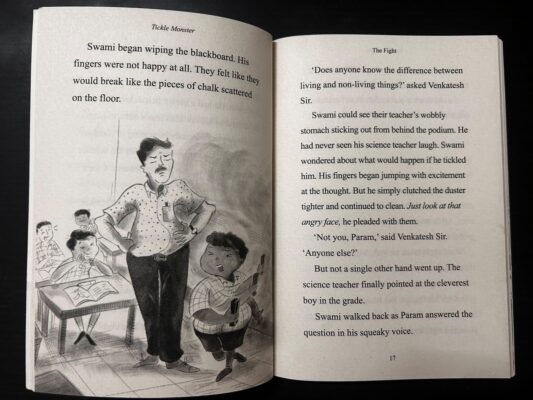
The illustrations by Chandrima Chatterjee are a lovely complement to the story. They capture the humour and mischief of Swami’s adventures really well and help bring the characters and their antics to life.
The illustrations also support the story without overwhelming it, making it easier for young readers to follow what is happening and connect the visuals with the text. For children who are still developing their independent reading skills, these visual cues can make the reading experience even more engaging.
📖 Independent Reading or Read-Aloud?
At 88 pages, Tickle Monster is a nice, manageable length for independent readers, especially children who are comfortable with short chapter-style stories.
But I think it works particularly well as a read-aloud.
The funny situations, Swami’s antics and all the Tickle Monster chaos give parents plenty of opportunities to pause, laugh together and ask, “What would you have done?” or “Do you think Swami realised he was hurting others?”
And that is perhaps one of the best things about the book. Beyond the giggles, it gives parents and children plenty to talk about—habits, bullying, boundaries, friendship, consequences and making better choices.
Sometimes the best conversations with children begin with a story that makes them laugh first. ❤️
ADDED BY ASHA: Other books by Prashant Pinge can be found here.
Adventure on Wheels is also a laughing riot – Aarini enjoyed it when she was a tween!
If you enjoyed this review and don’t like being tickled, you should order the book from Scholastic India (kbc affiliate link). Please type the name of the book in the search bar after clicking HERE.
Should you wish to order this book from Amazon (kbc affiliate link),
CLICK & BUY NOW!Disclaimer: Sindhuja and her daughter are a part of the #kbcReviewerSquad and received this book as a review copy from the publisher via kbc.