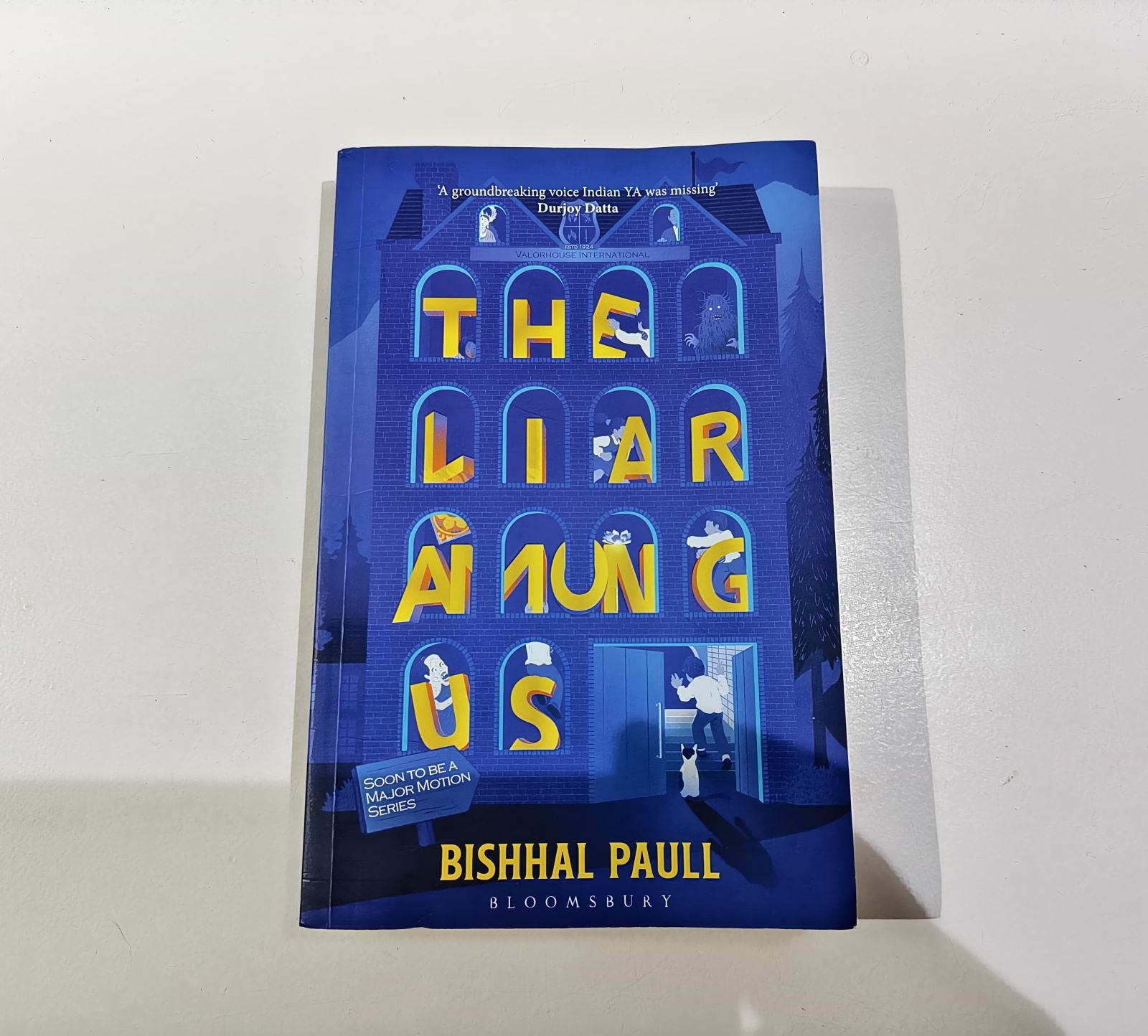
Title: The Liar Among Us
Author: Bishhal Paull
Publisher: Bloomsbury India
Type: Paperback
Length: 300 pages
Age group: 15 years+ (Young Adult)
The Liar Among Us tells the story of Angad Sandhu, a freshman who finds himself lost in the labyrinth of mysteries in Valorhouse, an elite school in Sikkim. The initial premise was gripping enough as it is, but the story itself also held me on the entire time while I was reading it.
Angad establishes himself as a protagonist you can get attached to instantly. He acts like a real teenage boy, his swagger explained by a practice he has been performing for years as a result of his trauma. His secrets feel heavy from the beginning itself, and one facet I always appreciated was how real he feels as a person. His internal monologue is so relatable at times, but that gets hampered a bit, which I’ll go over later.
An underrated aspect I noticed is the realism in the character movements. For example, it absolutely makes sense that Angad would be an athletic person in pivotal moments in the story – he is a nationally competing swimmer, after all. No, the other characters can’t suddenly run at the speed of light if need be, they are not at the same level or strength. It’s a small detail that many may miss, but the effort is appreciated.
The other characters have their own roles within the story, however, they can be one-dimensional at times. My favourite of the lot was Sree, Angad’s roommate, who experiences systemic casteism by both the students and faculty of the school. I really appreciated how the story handled Sree’s identity, though you may have to take my words with a grain of salt since I have been privileged enough not to experience this myself. The story doesn’t shy away from showing how Sree would have been treated, not just through the big moments but the quieter ones too, both words and description. Despite having a somewhat detached personality initially, he is still human and his raw emotions and reactions are incredibly well-portrayed. I felt the frustration through the pages and, as a general plus point, this book handled the portrayal of emotions incredibly well.
Also, he’s a nerd as well as a dancer, so I think my personal bias may be popping out here.
The antagonist, Krish, is fun to read but not as complex as I hoped he would be, though I do see that there is room for a sequel, so I’m willing to give a little grace there. His dialogue is written a little strangely, at times it feels realistic and others, feels as if someone is attempting to recreate a teenager’s dialogue on a Netflix show, which is odd since it’s usually one or the other.
The female characters, however, I do have a few issues with. Almost every single female character has some romantic entanglement with a male character, and worse, most of them are not developed beyond what they supplement to the story or to other male characters. Angad and Sree, for example, are well-developed characters beyond their female romantic interests or friends, whilst the female characters I could not tell you much about beyond maybe a skill or two. Credit where it’s due, Arisha is an engaging character to read and has a lot of depth to her, however, even her actions and motivations are largely guided by the male characters around her. It feels upsetting because of how much potential was there with them.
Speaking of characters, I could sense that there would be queer representation in the book (strange, I know) and there absolutely was. Though it was not explored in detail, that can be attributed to the protagonist’s priorities differing and not being as close to said characters, which is fairly understandable. I enjoyed it, personally.
Moving on to the writing itself – the pacing. For most of the book, the pacing is very well-maintained, and events don’t rush or feel out of place. That being said, there are instances – sometimes important ones – where the text sounds like, “This happened, then this happened, then this happened.” A lot of information or description is clumped on a page when it could be cut out or spread out more evenly. Overall, though, it doesn’t give me whiplash or leave me bored, so any reader won’t feel disoriented.
A personal nitpick that others may not see a problem with was the way certain scenes were written – it felt as if they were meant to be translated to screen. Like the classic, ‘shocking information received BUT suddenly there’s a deer on the road and you have to swerve’, it’s more of a visual trope than a written one. A few scenes like this made it feel more like it was meant to be shown than read, though I do see that it’s going to be adapted soon, so that will go over well once it’s time. As a reader, though, it felt as if the author was sometimes more used to or comfortable with a visual medium – which makes sense, considering he’s a filmmaker!
And my biggest gripe with the book – perspective. Out of everything I loved about this book (and trust me, I did), this almost put me off to a great extent. The author has chosen to work with two perspectives i.e., first-person and omniscient perspective. However, these two perspectives are not compatible in the least, in my opinion. The first-person perspective is intended to be limiting, and that’s why it’s a personal favourite of mine. A reader is stuck in the character’s head, knows only what they know, sees only what the protagonist assumes is right – it’s almost unreliable narration at times. Omniscient perspective, however, means that the reader is aware of everything relevant that occurs, on a factual level. This created a lot of confusion in me, at least, because initially I was so confused as to where the protagonist was and how he was aware of this – but he wasn’t. It’s up to the reader to sort through what he knows and what he doesn’t, despite the narration remaining in the first-person perspective. This is part of what contributes to the ‘show rather than book’ feel. Granted, it can be frustrating to transmit information just by following a single person and therefore an alternative could have been writing from a third person point of view, another term for it being ‘limited omniscient’ point of view. It would have been a more comfortable transition between the two, and it wouldn’t be as frustrating to read.
Moving on to one of my favourite parts of the book, though, the mystery. Oh. My. God.
I cannot understate how much I love that Madhab haunts the narrative. His presence feels heavy despite him not even being there. Not for a moment did I forget the mystery, or lose interest. The way the pieces slowly started coming together and secrets were slowly unveiled was BEAUTIFUL. The best part about this book is that it never let me put it down. It laced itself with inviting secrets and stories untold and hooked me to keep turning its pages. I didn’t want to stop reading.
And the magical realism. This is the first time I have read a long-form novel with magical realism and now I want to keep reading more for the same feeling. The mythological references flew over my head, but I never felt lost – I wanted more. It didn’t detract from the mystery or create any deus ex-machina, but supplemented the story so beautifully and added to the feeling of being watched, being haunted.
Overall, it was an incredibly enjoyable read and mystery. Every character played their part well, none felt out of place and the story progression was well done. Despite my critiques, I would definitely recommend this as a mystery to others.
If you enjoyed this review and wish to order the book from Amazon (kbc affiliate link),
CLICK & BUY NOW!Disclaimer: Asmi a part of the #kbcReviewerSquad and received this book as a review copy from the publisher via kbc.