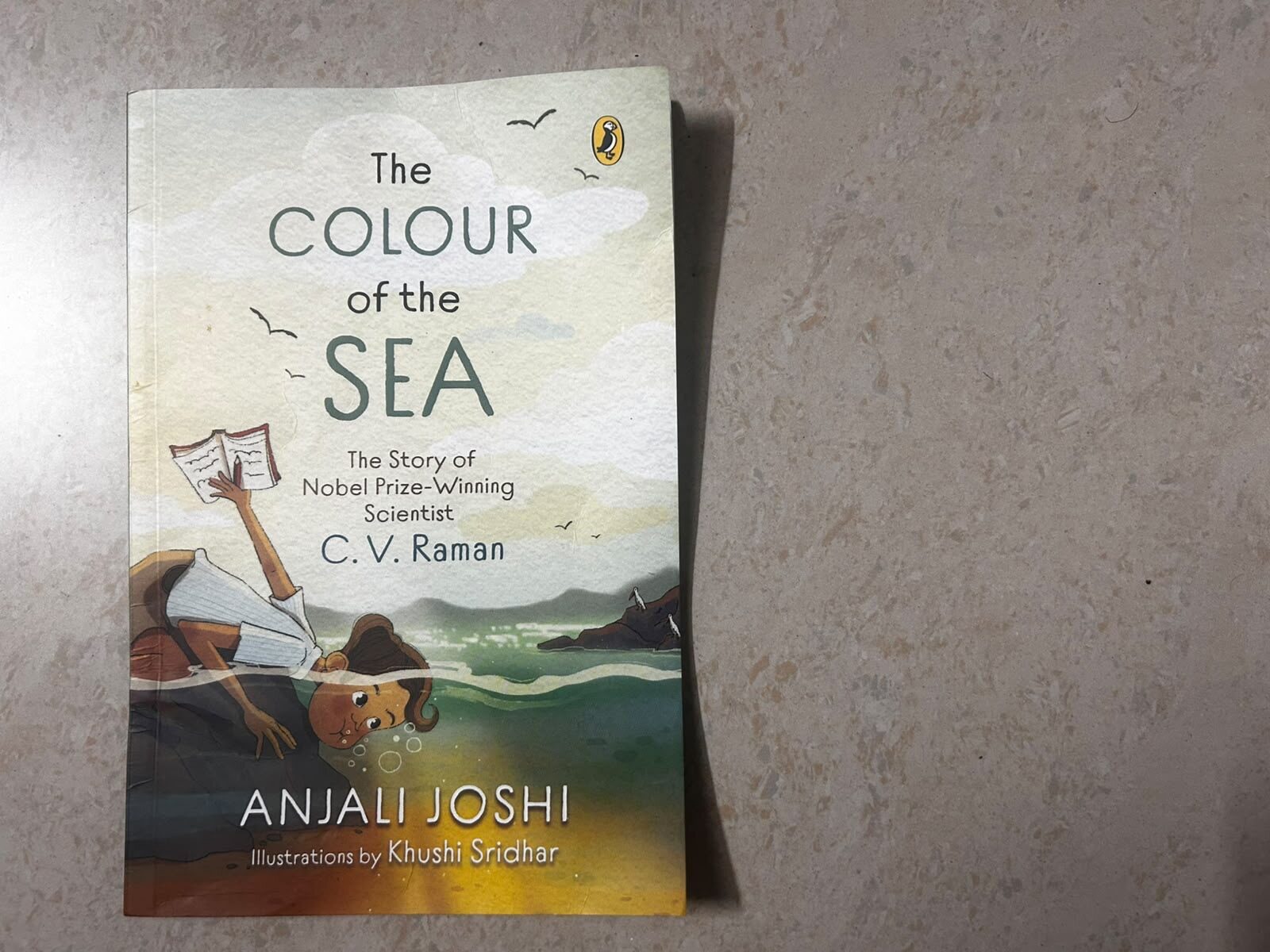
Title: The Colour of the Sea: The Story of Nobel Prize-Winning Scientist C. V. Raman
Author: Anjali Joshi
Illustrations: Khushi Sridhar
Publisher: Puffin / Penguin Random House India
Length: 40 pages
Format: Paperback, full colour
Age: 8 years+
Genre: Non-fiction / Illustrated biography /STEM biography
A book that will inspire you to start your own little experiment!
What do you get when a child refuses to accept a perfectly reasonable-sounding answer?
A Nobel Prize-winning scientist, apparently. 😄
The Colour of the Sea by Anjali Joshi, illustrated by Khushi Sridhar, introduces young readers to the fascinating story of C. V. Raman—not just as the scientist who won the Nobel Prize for Physics, but as the curious little boy who simply wouldn’t stop asking WHY?
Growing up by the sea, Raman wondered about all sorts of things—why a sitar produced different notes, how rainbows appeared and, most importantly, why the sea was blue. Someone apparently offered the rather obvious explanation that the sea was blue because the sky was blue.
Except Raman wasn’t buying it. 😄
If that was really the reason, then shouldn’t the sea change colour when the sky was cloudy and grey? That little observation was enough to send Raman digging deeper.
Armed with his spectroscope and an insatiable curiosity, he investigated the behaviour of light and eventually made the discovery that would become known as the Raman Effect, demonstrating the scattering of light and earning him the Nobel Prize in Physics.
And THIS is the part I absolutely loved about the book.
It doesn’t present science as something that begins with “Here is the answer. Please memorise it.” It shows children that science can begin with: “Hmm… that answer doesn’t quite make sense.”
And then comes the questioning. The observing. The experimenting. The let me find out for myself.
🔬 And then our own little science experiment began!
This book didn’t quite end when we finished the last page. 😂
Our discussion about Raman and the colour of the sea led to more questions about light, scattering and colours, which meant I ended up showing my daughter videos explaining how white light is made up of different colours and how light behaves when it interacts with different materials.
Which, naturally, led to more questions. Because apparently one answer is never enough once you’ve opened the WHY? door. 😄 Eventually, curiosity got the better of us and we bought a prism.
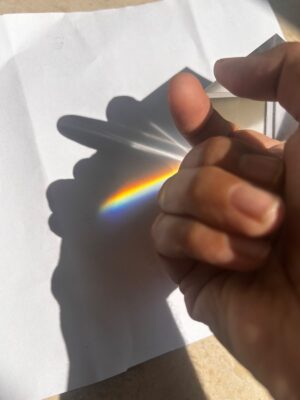
We then had our own little “C. V. Raman laboratory” at home, showing her how white light can be split into its spectrum of colours and talking about how different objects appear to have different colours because of the way they interact with and scatter light.
And honestly, this is what I love about books like this. A good children’s book doesn’t necessarily stop at “I learnt something.” Sometimes it turns into “But HOW does that happen?” And then into a YouTube rabbit hole. And then into buying scientific equipment. 😂
🌈 What we liked
I have been wanting to introduce my daughter to more prominent Indian scientists and personalities, but I was specifically looking for books that tell their stories rather than simply list their achievements.
The Colour of the Sea worked beautifully for us because it starts with something so wonderfully relatable—a child’s curiosity.
C. V. Raman wasn’t introduced to us as “the Nobel Prize-winning physicist.” He was introduced as the person who kept questioning something everyone else seemed happy to accept.
And that makes his story so much more meaningful for children.
The book also manages to introduce concepts around light, colour and scattering without turning into a textbook. There is enough science to spark curiosity, but the story keeps the young reader engaged.
🎨 The illustrations
Khushi Sridhar’s illustrations complement the story beautifully.
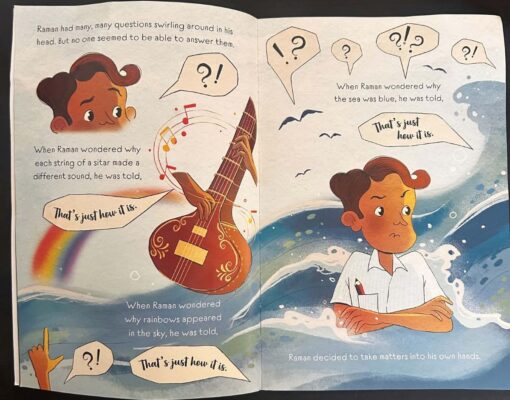
The soft, atmospheric artwork gives the book a lovely seaside feel, with the changing blues and greens of the sea, skies, rocks and underwater scenes making colour an integral part of the visual storytelling.
I particularly liked how the illustrations don’t merely sit alongside the text—they help create the world in which Raman’s questions begin. And the cover itself is quite lovely, with young Raman literally looking beneath the surface of the sea. 🌊
👧 Reading level
The book is recommended for 8+, and I think it works particularly well for children who enjoy science, biographies and stories based on real people. It can be read independently, but I would strongly recommend reading it together if your child is naturally curious, because there are SO many opportunities to stop and ask:
“Would you have accepted that explanation?”
“Why do you think the sea is blue?”
“What happens to light?”
“Where do all the colours come from?”
And before you know it, you’re explaining prisms at the dining table. 😂
⭐ Our Take
What stayed with me most after reading this book wasn’t just the Raman Effect.
It was the idea that curiosity is worth pursuing.
Raman could have simply accepted the explanation that the sea was blue because the sky was blue. Instead, he noticed something that didn’t quite fit, questioned it and went looking for an answer.
And that’s exactly what happened in our house after reading this book too.
One question about the sea became a conversation about light.
That became videos about the seven colours of the spectrum.
That became discussions about scattering.
And that eventually became “Let’s buy a prism and see this ourselves!” 😂🌈
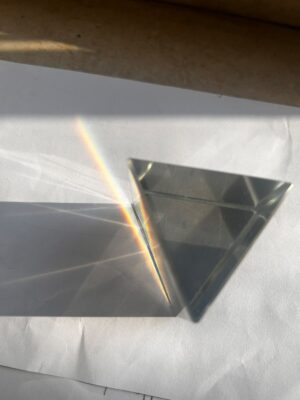
So yes, The Colour of the Sea taught my daughter about an extraordinary Indian scientist. But more importantly, it reminded us that science isn’t just about knowing the answers. Sometimes, it’s about being curious enough to question the answers everyone else has already accepted.
And if a children’s book can make an 8-year-old ask more questions and make her mother buy a prism, I’d say it has done its job rather well. 😄🔬🌈
There is another book in the series:
Catching the Sun and Wind: The Story of Anna Mani: India’s Weather Scientist by Anjali Joshi | Inspiring Biography | Explores Science, Weather and Renewable Energy | 8 years+ (40 pages)
If your child is curious and loves science, you might want to order the book from Amazon (kbc affiliate link),
CLICK & BUY NOW!Disclaimer: Sindhuja and her daughter are a part of the #kbcReviewerSquad and received this book as a review copy from the publisher via kbc.