
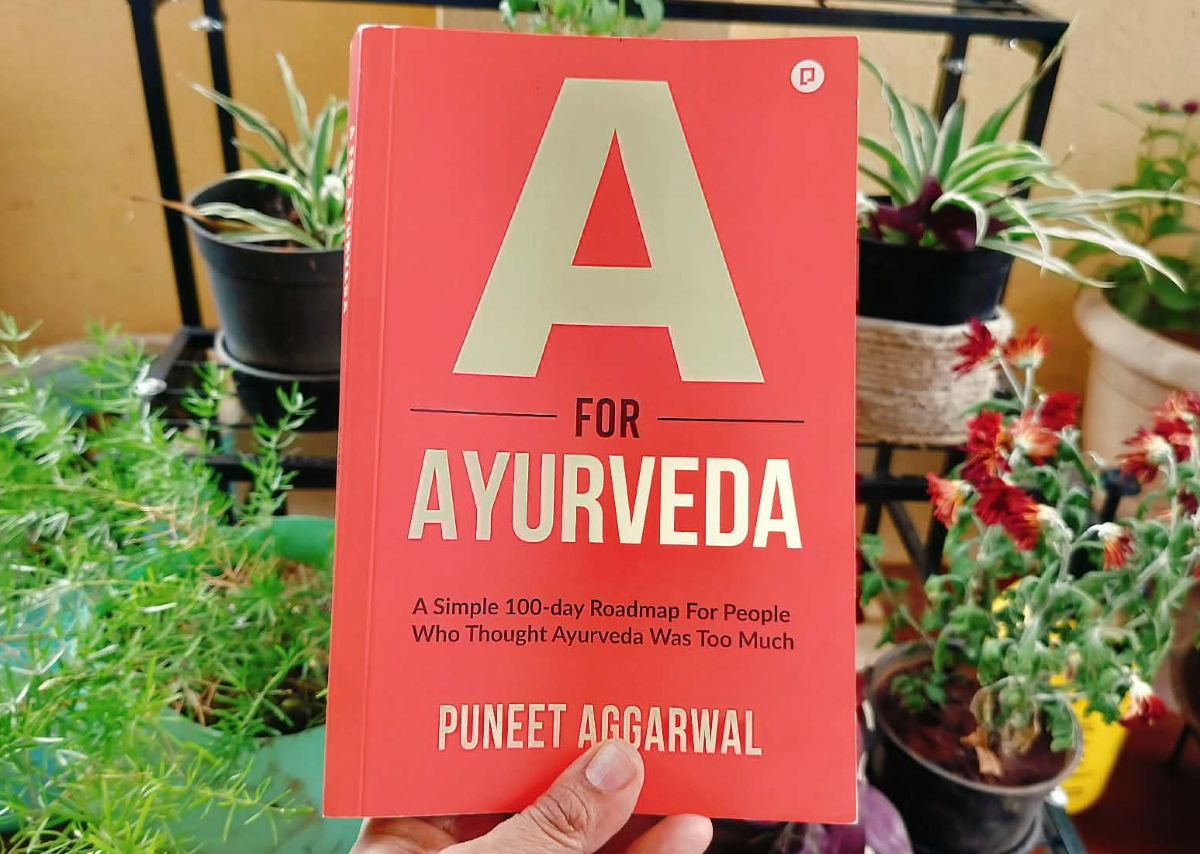
Title: A For Ayurveda: A Simple 100-day Roadmap For People Who Thought Ayurveda Was Too Much
Author: Puneet Aggarwal
Publisher: Pendown Press
Type: Paperback
Length: 214 pages
We at kbc, had an astonishing response to the Q & A session we had with Puneet Aggarwal, aka ThatAyurvedaGuy [Follow him on Instagram @ThatAyurvedaGuyDotCom where he shares easy, daily tips]. When some of our members read his book – the verdict was the same!!
The intention to make Ayurveda simple, structured, and actually usable in daily life.
Seethalakshmi aka Preethi has shared her detailed review:
A for Ayurveda by Puneet Aggarwal is one of those rare reads that feels thoughtfully designed from start to finish. Right from the index to the appendix, you can see the author’s intention: to make Ayurveda simple, structured, and actually usable in daily life.
Let me begin with a small disclaimer—I am writing this review even before completing the full 100-day roadmap. But the impact this book has already made felt too important not to share. It’s been about one and a half weeks since I started reading and gradually implementing its suggestions, and I’ve already begun noticing subtle but meaningful changes. That itself felt like a sign to talk about it.
At its core, this book is a simplified 100-day roadmap for anyone who has ever felt that Ayurveda is “too complicated.” Each day introduces a small habit or reflection point, designed to be implemented step by step. You are not expected to rush through it; if anything, the author encourages slowing down, staying with each practice for a few days, and letting it settle into your system before moving ahead.
That flexibility is what makes this book stand out. It doesn’t demand perfection. Instead, it supports consistency at your own pace.
From my personal experience, I’ve tried Ayurveda before for my autoimmune condition, but it often came with strict dietary rules and lots of medicines that I couldn’t sustain. What was missing in most approaches was a focus on preventive lifestyle changes. This book fills that gap beautifully. It made me reflect on what might have gone wrong earlier and how small, consistent shifts could actually support long-term healing.
What I appreciate most is that this book is more about preventive care and lifestyle alignment than just treatment. While it does include a section on addressing illnesses, the heart of the book is about daily balance—how we live, eat, move, and respond to our environment.
The language is simple, direct, and very easy to follow. It feels more like a guided conversation than a heavy manual. There’s also a sense of personalization throughout. You are encouraged to choose what works for you, stay with it, and build slowly.
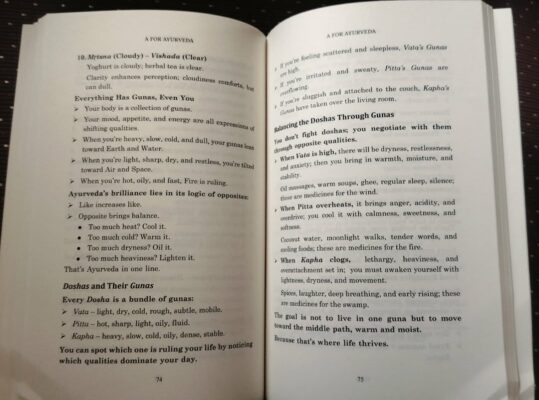
One of the most helpful additions is the questionnaire that helps identify your body type (dosha) and suggests ways to balance it. This creates a starting point for a more personalized journey rather than a one-size-fits-all approach.
A surprising insight for me was around movement and exercise. As a swimmer, I assumed I needed to push myself into more strength training, especially considering my age. I tried doing that, but instead of feeling stronger, I ended up feeling exhausted and sore. This book helped me understand why—my body naturally responds better to cardio, with only mild strength training. Swimming, which I had considered “just cardio,” actually aligns much better with my body type and leaves me feeling refreshed instead of drained.
That kind of clarity is exactly what this book offers: not rigid rules, but personalized understanding.
One of my favourite prompts in the book is Day 8: “Catch one imbalance and correct it.” Everything here is action-oriented. It doesn’t just explain concepts; it guides you to observe your body, notice patterns, and make small corrections in real time.
The book also gently teaches you to recognise rhythms—your internal cycles, your reactions, and how they interact with external environments. It emphasizes health not as perfection, but as a dynamic balance.
It also introduces concepts like dinacharya (daily routines) and ritucharya (seasonal routines), helping you understand how lifestyle shifts with time and nature. Even small changes in these areas can make a noticeable difference when practiced consistently.
Towards the end, the book becomes even more practical, offering “minimum effort” versions of the practice—what you can still do and feel like you’re following 80% of the system. That makes it less intimidating and more sustainable.
The appendix is especially useful. It acts like a quick reference guide, offering daily templates based on body types. It’s the kind of section you can return to anytime you feel lost or need grounding.
Overall, A for Ayurveda feels less like a book and more like a lifelong companion. It’s something you can revisit repeatedly at different stages of your life. I also genuinely plan to share this with friends and family because of how accessible and grounded it is. It’s the kind of book that could sit on a coffee table in a home, or in a wellness clinic, or even a resort.
I am deeply grateful to the author, Puneet Aggarwal, for creating something so intentional and reader-friendly. The clarity of purpose is visible in every section, right from the index to the appendix. Kudos to the author for making Ayurveda feel not overwhelming, but achievable. And thank you for this book.
To order the book from Amazon (kbc affiliate link),
A book you will go back to again and again.
MAHIMA shared her review in the kbc fb group here:
The word Ayurveda can be very overwhelming. But for ages we have all been into it knowingly or unknowingly. Growing up I spent a lot of time with my grandpa and have seen him using so many plants and spices for health and healing. Back then it felt like “blahh, not again”, but when I had my son Aarav, I realised how much those helped me. Now, when I was reading this book it was like putting some puzzle pieces together.
In Telugu layman terms Ayurveda is called “perati vaidyam” – backyard treatment in translation, literally. The content is not overwhelming, Puneet ji has connected the dots on why we have to do something in a certain way and how it helps. It’s easy to understand, the language is simple and the shlokas are broken down to explain in simpler terms. There are some very interesting and important take-aways.
For eg – The Gut Health – the perspective “it’s the mini kitchen”, the fire of our system of our body. Now imagine it this way, you close your kitchen at home for a day…. Puneet ji has explained the do’s and don’t’s for good gut health and it’s importance. What’s the right way to consume food – like a warm breakfast to wake up your gut in the morning. A detox to reset your gut after a set back or issue….
If you are someone who enjoys seasons and what they bring along then Ritucharya will be your favourite just like it’s mine. How you can build your health with the seasons in play. Then the Mind – Body connection changes how you perceive the entire system of yours.
These are a few things I’ll add if you plan on buying this book. This book is not a casual read kinda one – read it with intent. Even if the 1st time you have just read it, go back to it again.Don’t miss the Preface, you really have to know the work that’s gone behind it and you will need to understand the importance of habits with respect to Ayurveda as a lifestyle. Why’s, How’s and When’s – explained by Puneet ji.Go one page or one topic at a time. Let it sink in and if you are trying to follow, then journaling changes the whole game.If you think you need a break after a topic take it. I felt that it would make a difference, especially in being able to follow, incorporate the new changes better into our lifestyle. Keep a pencil handy, just make note of things at the bottom of the page if you can’t grab a book to paper. Use stick notes to journal and look back that way your reference will be more clearer. It will also help you understand – what worked, what didn’t and why.
Thank you for this wonderful book Puneet ji. I read it, but I’m gonna go back to it again with more intent this time around. It’s changed the way I now look at Ayurveda as a science or medicine.
The most practical and accessible books on health and well-being!
KHYATI shared her review with some inside pages in the kbc fb group here:
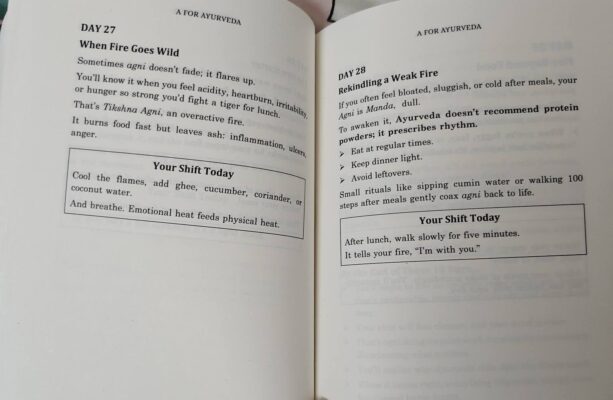
When we hear the word Ayurveda, we think of ancient knowledge; difficult to adapt in our modern world. This is exactly what is subverted in a book I recently read ‘A for Ayurveda’ by Puneet Agarwal. It has been one of the most practical and accessible books on health and well-being that I have come across. What I appreciated most was the day-wise format, which breaks down Ayurvedic principles into simple, manageable steps. Rather than feeling overwhelmed by a vast body of knowledge, I was able to focus on one concept at a time and gradually incorporate it into my daily routine.
The language is very simple, making even complex ideas easy to understand. Puneet Agarwal uses vivid metaphors and relatable examples throughout the book, which helped me grasp concepts that I had previously found difficult to understand. I particularly enjoyed how the book explains the connection between the elements of nature and the human body. These explanations gave me a deeper appreciation of how Ayurveda views health as a balance between our inner and outer worlds.
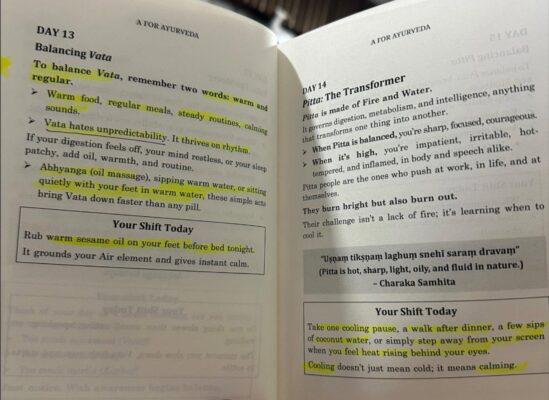
Another feature I found extremely useful was the actionable takeaway at the end of each entry. These practical suggestions encouraged me to move beyond simply reading about Ayurveda and actually apply its principles in my everyday life. Small changes in my habits, diet, and daily routine have helped me become more mindful of my health and overall well-being.
What makes this book stand out is its ability to make ancient wisdom relevant to modern life. It is informative without being overwhelming and practical without being prescriptive. For anyone curious about Ayurveda or looking for simple ways to improve their lifestyle, *A for Ayurveda* is an excellent place to start.
Additionally, do subscribe to Puneet’s emails [puneet@thatayurvedaguy.com] and you’ll have a daily short tip in your inbox. He also shares these daily tips on Instagram @ThatAyurvedaGuyDotCom.
It’s exactly what it says it is on the book cover – A simple 100 day roadmap for people who thought Ayurveda was too much.
Serendipity – strange how it works. I was sent A for Ayurveda book as a prize for winning a prompt. Got it just a day before travelling to hometown for summer vacation. I had activity books to keep kids engaged thanks to recommendations by kbc, so I took this book hoping to get time to atleast start reading it. To my pleasant surprise I was able to finish the book in a 8 hour journey with me and the kids. I was thinking that book will be about history and branches and all the theory about Ayurveda. But to my suprise it delivers exactly what it says in front page. It’s a simple 100 day roadmap for people who thought Ayurveda was too much.
I had the following questions over few years:
1) Why do I find it easier to eat my heavy meal after 12:30?
2) How do I differentiate between what to eat and for which season?
3) What daily routine should I follow? What are the bare minimum things to be done?
4) If I know the cause how to find solution?
5) How to stop myself scrolling even though I am too tired?
6) How to be conscious of food, information that I consume?
7) When to eat heavy and when to eat light food?
8) Why am I active energetic sometimes and tired lethargic other times
9) I knew I got sick last month because of overwork, what signs did I miss? How can i manage and bring my balance back?
I never expected to get answers and clarity in many things that I used to wonder about in this book. I did my Btech in biotech, so I had a slight idea about the strengths and weakness of pharma. I learnt to experiment on myself, so I have a soft spot for productivity hack books that give a detailed step by step process.
This book went one step ahead and explained the basics/the building blocks and slowly added another layer of complexity over another. It showed beautifully how things are connected and how an imbalance shows itself outside. It does not burden us with random tips but teaches how to diagnose and use common sense to restore balance.
To order the book from Amazon (kbc affiliate link),
CLICK & BUY NOW!Disclaimer: Seethalakshmi, Prashita, Mahima, Khyati and Pooja won this book as a prize in the #kbcAForAyurveda Contest powered by Nirogam and kbc.


